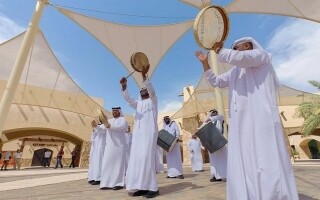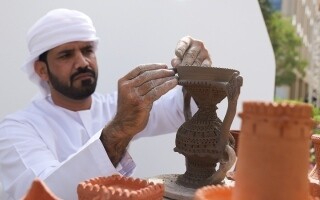
The young Emirati talent, Saeed Al Shihhi, excels in shaping clay, transforming it into exquisite historical artifacts and tools. He showcases his creations at Ain Square during the Al Ain Book Festival, organized by the Abu Dhabi Center for Arabic Language, offering visitors the chance to learn the art of pottery through workshops held as part of his participation in the festival, which concludes today.
In his dedicated pottery corner, Al Shihhi presents a collection of local traditional instruments, including the traditional "Dallah" (coffee pot), "Barmah" (a cooking pot), "Yahla" (a water vessel), and "Khors" (a container for storing and cooling water or food). He also displays various forms of incense burners or braziers that blend the richness of the past with the elegance of the present. These include a two-story burner named the "Covered Burner," a burner shaped like the historic square fortress of Al Ain, and another styled after the Al Hisn Fortress.
Over 15 years dedicated to his craft, Al Shihhi has honed his skills and creativity, crafting unique clay models of forts and castles, such as the pre-Islamic Jahili Fort in Al Ain and the Al Mirrah Fort in Liwa. He has also distinguished himself in the art of pottery engraving, etching the emblem of the state on some burners and depicting motifs of palm trees and "Sadu" (traditional weaving patterns) inspired by old Emirati houses, which he creates using special wooden engraving tools made by his own hands.
Al Shihhi stated: "My passion for pottery began when I was 12 years old. It is a traditional craft I learned from my parents and grandparents. I was born and raised in Ras Al Khaimah, a region distinguished by its mountains and valleys, making it fertile ground for various types of clay. There, we collect the clay—red, yellow, and green—and mix it, cleaning it from stones. We then knead it with water to create what is locally known as 'Ghaila.' After that, we shape it according to demand and craft a variety of traditional tools."